Paycom's HR teams were managing leadership pipelines in spreadsheets, slide decks, and disconnected meetings. I designed the tool that changed that, adopted by 200+ clients and cited as a key factor in client renewals.
Should the system decide placement, or should it support better human decisions?
Context
Succession planning determines who becomes tomorrow's leaders, yet most organizations still manage it through spreadsheets, slide decks, and disconnected conversations.
Decisions are made in meetings, documented inconsistently, and often lose context over time. HR and managers rely on different signals, alignment breaks down, and leadership readiness becomes difficult to track or defend.
This project focused on designing a system that didn't just capture placements, but helped organizations make clearer, more explainable leadership decisions together.
Where Things Started
Leadership pipeline visibility directly affects retention, internal mobility, and long-term workforce planning.
Without a centralized succession process:
Performance ratings tracked manually and updated inconsistently across teams
Managers documented performance and potential in separate files with no shared structure
Decision context buried in email threads and hard to revisit later
Alignment across HR and managers broke down over time
Organizations weren't just missing a tool. They were missing a shared decision framework.
My Role
As Lead Product Designer, I owned this experience from concept through launch across desktop and mobile. I defined the core interaction model, shaped product direction through early ambiguity, and partnered across product, research, and engineering as permissions and governance constraints surfaced. I also collaborated with another designer on mobile workflows and with design system partners to document reusable patterns for broader adoption. This was not just an interface challenge. It required aligning how HR, managers, and leadership each believed succession decisions should happen.
Defining the Product Direction
Early conversations surfaced a fundamental tension. Product initially leaned toward system-driven placements based on performance data. HR emphasized leadership potential, manager judgment, and contextual understanding.
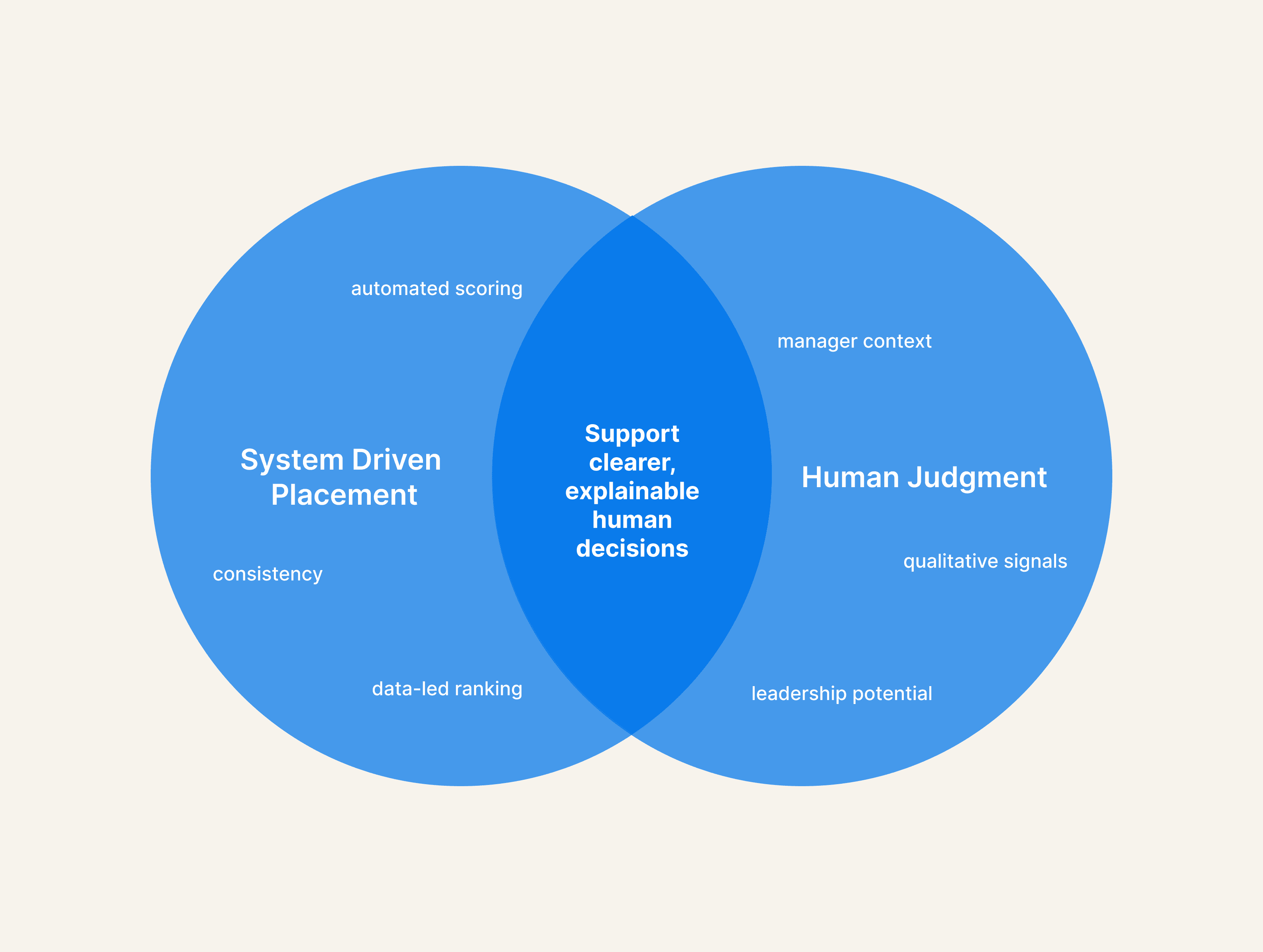
That tension shaped the entire product. We anchored on a core principle:
The goal was not to automate succession planning. It was to make placement decisions clearer, explainable, and collaborative.
Key Constraints That Shaped the Experience
Performance needed an objective foundation
Completed reviews and assessment data informed the performance axis. This grounded conversations in shared signals.
Potential remained discussion-driven and guided by manager context rather than automated scoring.
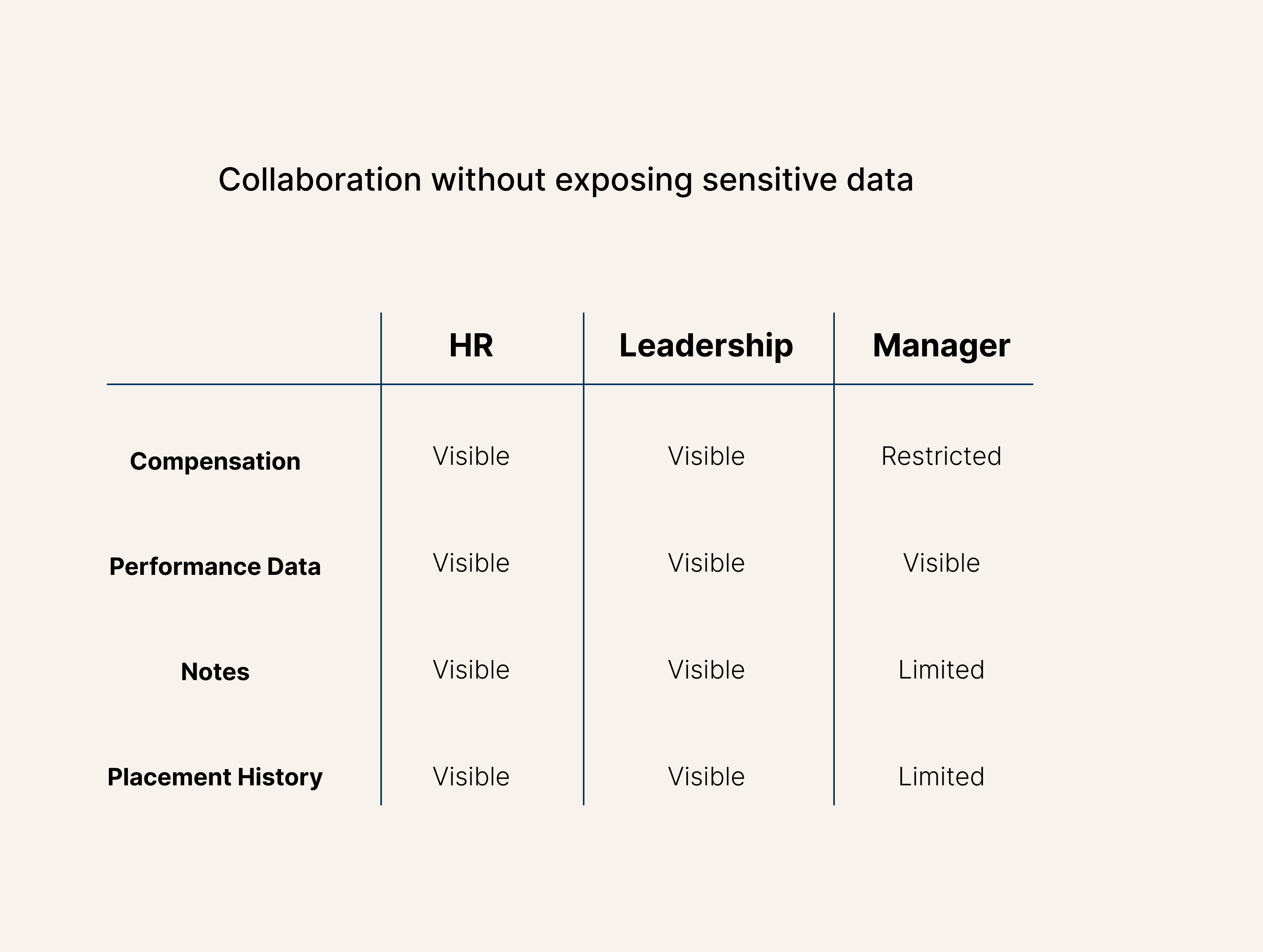
Sensitive data changed the architecture
Compensation and employee details required strict role-based visibility. Collaboration needed to happen without exposing information across departments.
Permissions and governance became core design considerations, not backend details.
Mobile couldn't mirror desktop
Early designs explored full editing on mobile. Research revealed succession decisions happened in structured discussions, often with multiple stakeholders present. happened in structured discussions, often with multiple stakeholders present.
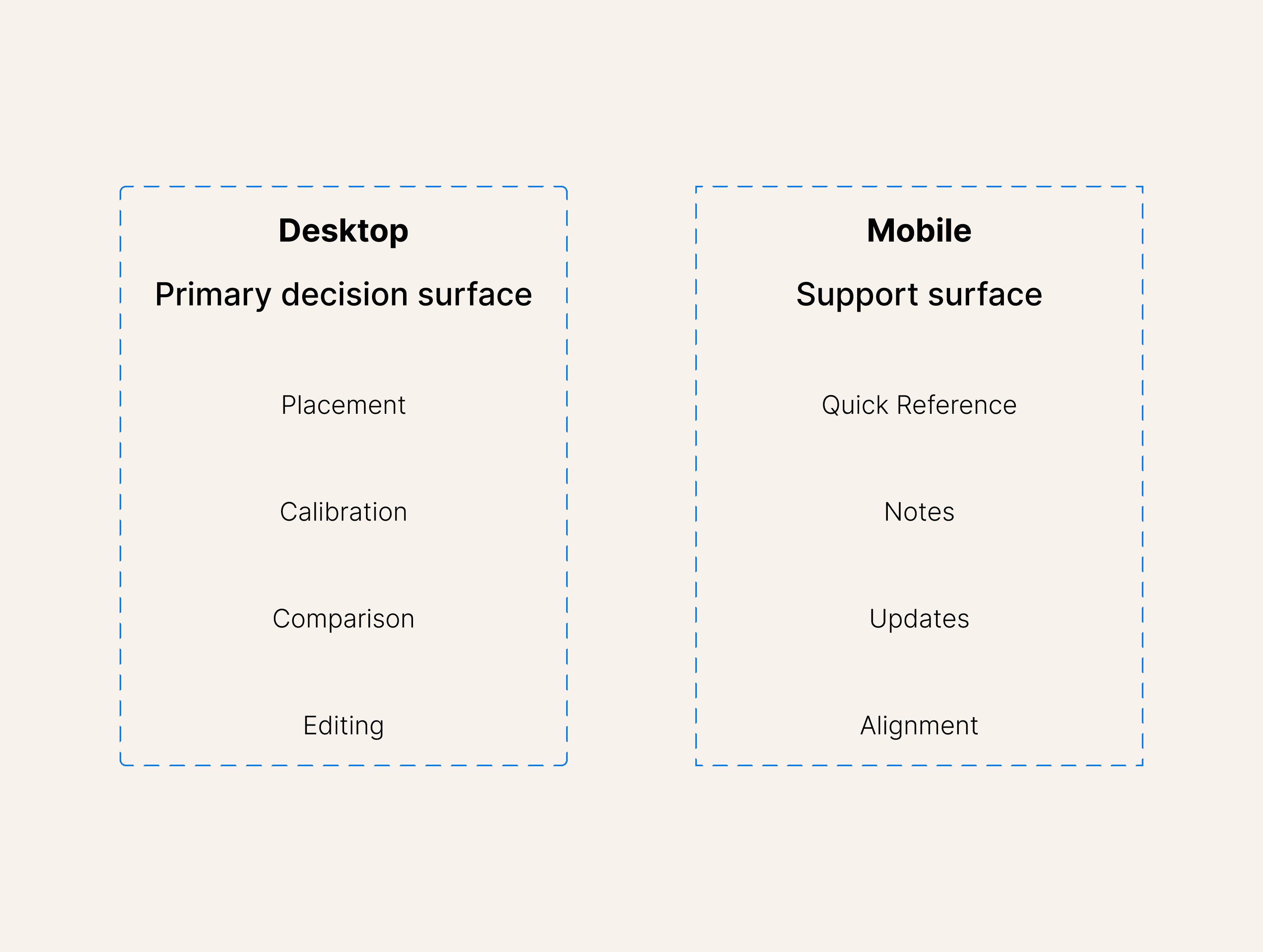
Mobile evolved into a support tool, not a primary decision surface.
Quick reference during conversations
Capturing notes
Staying aligned with placement updates
Too much data slowed decisions
Early versions surfaced extensive employee context. Instead of helping, this created friction during calibration.
We prioritized signals needed for placement first and moved deeper information into expandable layers.
Design Decisions
1. Real-time placement inside the grid
Managers needed to move employees during live discussions without breaking flow. Edit panels and modal workflows slowed comparisons and removed context.
Drag-and-drop enabled immediate visual placement, side-by-side comparison, and real-time collaboration while preserving decision context. Accessibility and keyboard interactions were built in, and the interaction model was later documented with design system partners for reuse across talent tools.
2. Talent Profiles became decision hubs
Managers previously relied on personal notes and separate documents because information lived across systems. Talent Profiles centralized performance history, assessment signals, feedback and development context, and placement rationale, shifting profiles from static records to decision hubs where the reasoning behind decisions stayed visible over time.
3. Mobile supported real behavior
Research revealed placement changes rarely happened between meetings. Mobile became a tool for referencing employee context, capturing notes during discussions, and staying aligned with updates. This reduced governance risks while supporting real manager behavior.
The Pivot: Designing for Confident Decisions
As the system matured, a new challenge emerged. Access to information wasn't the problem anymore. Decision clarity was.
Early Talent Profiles pulled in a wide range of inputs:
1.
Performance History
2.
Manager Feedback
3.
Peer Observations
4.
Development Notes
The intention was completeness. The result felt heavy and harder to use during real conversations. We shifted direction.
Performance placement anchored to objective signals from completed reviews and assessments
Potential remained grounded in manager discussion
Qualitative inputs stayed accessible but no longer competed with core placement signals
Key indicators surfaced first. Deeper context remained available when needed. This reframed the product from a data repository into a decision-support system.
Looking back: I would have defined permissions architecture earlier. It became foundational to the product and surfaced later than expected, which compressed engineering timelines toward the end of the build.
Impact
0%
0%
Mobile activity within 3 months of launch
Within 3 months of launch
0+
0+
Clients adopted the tool at launch
Scaled to entire platform user base
0+
0+
Reusable design patterns adopted across Paycom's talent management suite
Framework adopted across talent management tools
0
0
Clients cited succession planning as a key factor in their decision to renew with Paycom
Cited succession planning as a key factor in their decision to renew with Paycom.
Behavioral Shift
The most meaningful impact wasn’t captured in metrics.
Succession planning moved from fragmented, meeting-driven coordination to a shared system where placement decisions, supporting context, and reasoning stayed visible over time.
Managers no longer relied on private notes or disconnected files. HR gained consistent visibility into readiness and potential. Leadership conversations became anchored in shared signals instead of individual interpretation.
Reflection
This project reshaped how I think about designing for complex large-scale systems. The challenge wasn't the grid, the profiles, or the interface. It was aligning how different groups believed leadership decisions should happen. Product leaned toward consistency through structured data. HR focused on context, observation, and leadership potential. Engineering surfaced governance and permissions constraints that reshaped interaction design. The most meaningful progress came from navigating those tensions and designing a system that supported human judgment rather than replacing it. Looking back, I would have introduced mobile usage instrumentation earlier and invested more time upfront defining permissions architecture. Both became foundational to the product and surfaced later than expected.